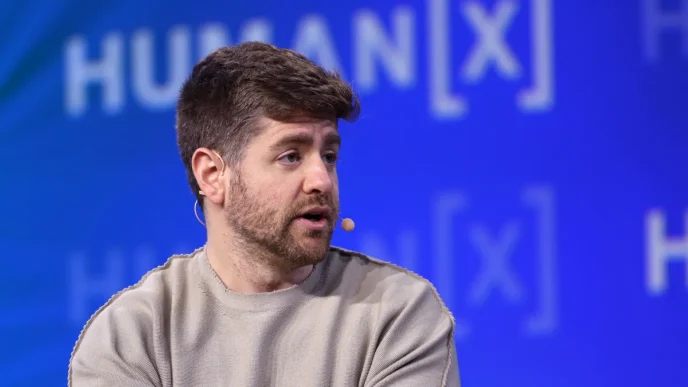

Mark Zuckerberg, the founder and CEO of Meta, recently published a sprawling 6,500-word treatise on artificial intelligence. This extensive document, outlining his vision for spreading AI’s benefits and addressing skeptics, clocks in at roughly one-tenth the length of an average novel, and a full ten times longer than his previous article on “Personal Superintelligence” a year prior. It represents a growing trend among the titans of the tech industry, where lengthy essays have become the preferred medium for articulating grand visions.
Zuckerberg is far from alone in this endeavor. Dario Amodei, CEO of Anthropic, set a new benchmark earlier this year with his monumental 13,000-word piece, “Machines of Loving Grace.” Nvidia’s Jensen Huang has also contributed to this burgeoning literary genre, alongside other prominent AI chief executives. On the surface, the rationale behind these exhaustive writings appears sound: with Wall Street closely scrutinizing Meta’s substantial investments and rival labs fiercely competing for dominance, these leaders aim to meticulously detail their strategic roadmaps. Their stated goal is to engage regulators and the public, drawing clear boundaries around AI’s potential utility even before products hit the market. As Columbia Business School professor Dan Wang observed, “They have to draw the boundaries around why AI can be useful even before they begin selling products.”
However, not everyone interprets these verbose pronouncements with such a charitable view. Patrick Riccards, a communications specialist, offered a more critical perspective, suggesting that “CEOs, particularly tech CEOs, believe that their words are gospel.” He characterizes these essays as territorial markers, essentially “flags planted in the ground,” where “you essentially have five or six tech CEOs that are trying to demonstrate whose…[shall we say essay] is bigger.” This competitive display raises a fundamental question in an age of diminishing attention spans: do these colossal manifestos truly resonate beyond a narrow circle of industry insiders, and if not, what real purpose do they serve?
For a stark contrast and a model of effective long-form communication, one might consider Warren Buffett. For decades, Buffett’s annual letters to Berkshire Hathaway shareholders routinely exceeded 10,000 words. These letters delved deeply into the year’s financial results and broader business lessons, often infused with his characteristic folksy wisdom. Yet, their length was never their primary appeal. Buffett deliberately crafted his prose to be accessible to anyone, famously envisioning himself explaining the business to his own sisters—intelligent individuals outside the financial world. Readers engaged with Buffett not because he wrote extensively, but because he had, over decades of consistent results, earned the credibility to be heard, and then chose to communicate plainly. His successor, Greg Abel, maintained this tradition in his first CEO letter this year.
The crucial distinction lies in the intended audience. Buffett understood precisely who he was addressing. Zuckerberg, Amodei, and their peers, it seems, are largely writing for each other—a self-referential loop of founders, investors, and the journalists who cover them, each essay often responding to the last. This insular dialogue may not be the most effective strategy when facing broader public concerns. Zuckerberg, for instance, grapples with public apprehension regarding data centers impacting local communities and a widespread distrust of Big Tech. A 6,500-word manifesto, however well-intentioned, appears unlikely to sway public opinion or alleviate deep-seated skepticism. If there is a singular lesson any CEO can glean from Buffett’s approach, it is that the act of writing is relatively straightforward; earning the right to be genuinely read and understood by a diverse audience is the far more challenging endeavor.