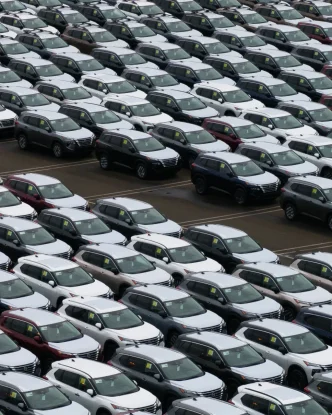

The numbers are staggering. In 1995, Nissan stood as the 23rd largest company globally by revenue, a formidable presence with $58.7 billion. Today, it ranks 168th, having reported a $3.54 billion loss in its last fiscal year on revenues of $79.7 billion, a 4% dip from the year prior. This precipitous decline underscores a critical question facing not just Nissan, but the entire automotive industry: can the traditional model of a globally integrated car manufacturer survive in an increasingly protectionist and competitive landscape?
This challenge landed squarely on the shoulders of Ivan Espinosa, a 46-year-old product engineer from Mexico, who stepped into the CEO role after merger talks with Honda collapsed. Espinosa, who began his career with Nissan in 2003, had witnessed the company’s struggles firsthand across various international postings before becoming chief planning officer in 2024. His ascent to the top, particularly as a non-Japanese national in a company founded in 1933 and traditionally led by Japanese executives, signaled a desperate pivot. He recognized the urgent need to “resize the company,” a sentiment he shared with Fortune, understanding that Nissan’s predicament was symptomatic of a larger industry shift.
Espinosa’s response was the “Re:Nissan” plan, unveiled in May 2025, just six weeks after his appointment. This aggressive strategy aims for 500 billion yen ($3.1 billion) in savings, seven plant closures, 20,000 layoffs, and a drastic reduction in development cycles to just over two years. While these measures are designed to return the company to profitability in the current fiscal year, automotive analyst Takaki Nakanishi of Astris Advisory notes the inherent difficulty: “It’s easy to cut costs. It’s more difficult to restore the value of the brand.” The path forward for Nissan involves a strategic reorientation around two primary ecosystems: China and the United States, a departure from the previous global one-size-fits-all approach. 
The North American market, particularly the U.S., remains central to Nissan’s revitalization, accounting for over 40% of its vehicle sales. Christian Meunier, Nissan’s Americas chair, described a company he “didn’t recognize” upon his return in 2025, prompting him to aggressively strip out $2 billion in fixed and variable costs within 12 months. However, the division faced external headwinds, notably the 25% tariffs on imported passenger vehicles imposed by former U.S. President Donald Trump in March 2025. While subsequent trade negotiations reduced tariffs on Japanese cars to 15%, the initial shock forced Nissan to significantly re-evaluate its supply chains. Meunier reports reducing tariff exposure from $4 billion to $1.5 billion, achieved by intensifying efforts with suppliers to identify U.S.-made components. Mexico continues to play a vital role, producing entry-level models like the Sentra and Kicks, which are difficult to manufacture profitably in the U.S. This strategy addresses the growing affordability crisis for new cars in the U.S., with Nissan seeing an 8.3% jump in U.S. sales in the first half of 2026.
China presents another complex challenge and opportunity. Despite a 6.3% decline in sales to 653,000 vehicles in the last fiscal year, Nissan aims for one million sales in the country by the end of the decade. More profoundly, China has become a critical learning ground. Alfonso Albaisa, Nissan’s senior vice president for global design, credits the “collapse in China” with a “massive come-to-Jesus moment,” highlighting the “simply stunning” pace of Chinese designers. This “China speed” is now being integrated into Nissan’s global operations, reducing design decision-makers from twelve to three and leveraging AI and digital tools over traditional methods. Nissan’s Los Angeles studio, for instance, has been transformed into a prototype design operation with a lean team and advanced computing power.
The shifts at Nissan are not isolated. Other legacy automakers face similar pressures: Honda posted its first annual loss last fiscal year and scaled back EV plans, while Toyota’s CEO was replaced after a $9 billion hit from Trump’s tariffs. Six of the twenty largest losses on this year’s Fortune Global 500 were from car companies, underscoring the systemic disruption. The traditional global manufacturing model, characterized by vast cross-border supply chains, is being re-evaluated amidst the EV transition, new Chinese competition, and supply-chain vulnerabilities. Nissan, under Espinosa, is evolving into a “regional multinational,” sharing technology and platforms but adapting production to hyper-regional markets. While recognizing the need for market-specific solutions, Espinosa cautions against complete fragmentation, stating that “it’s crazily inefficient” to create entirely distinct solutions for each region. The role of Nissan’s headquarters, he believes, is to provide “guardrails” that encourage innovation while maintaining economic viability, a strategy that hinges on the engineering prowess he believes defines the company.