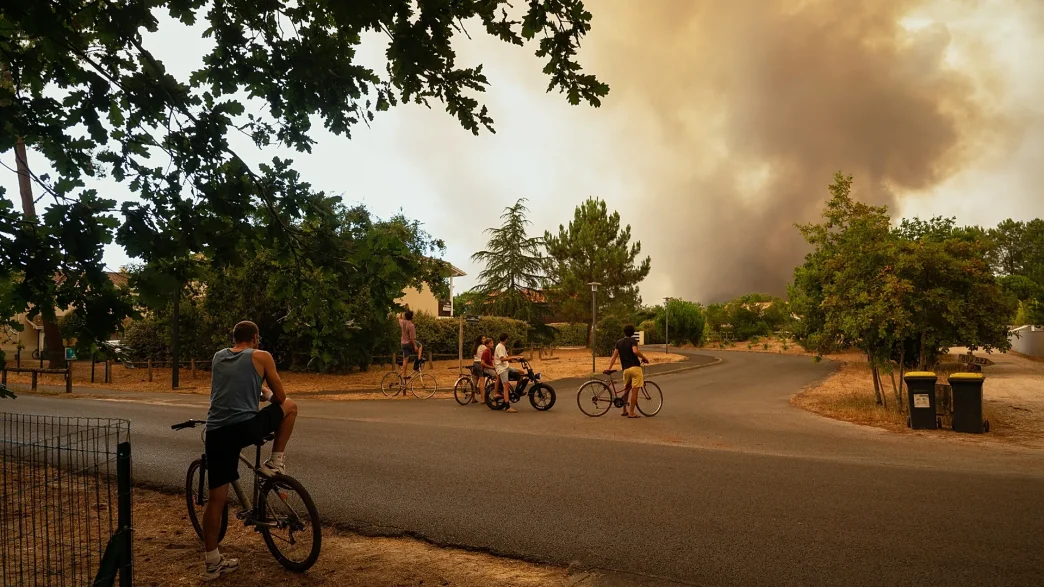
More than 320,000 individuals have been displaced across France and Spain as wildfires continue their destructive path through southern Europe. The sheer scale of these evacuations underscores the escalating intensity of the blazes, particularly evident in southwestern France where the situation has prompted a massive coordinated response. In the Gironde region, five additional villages around Bordeaux were ordered to evacuate on Saturday night, pushing the total number of people forced from their homes in that area alone past 220,000. The combination of parched landscapes and strong winds has proven a formidable adversary for firefighters, allowing the primary blaze to spread with alarming speed, consuming approximately 42,000 hectares.
French Interior Minister Laurent Nuñez characterized the situation as “highly unfavorable,” noting the Gironde fire’s “extremely fierce and unpredictable” behavior, especially during evening hours before a slight calm set in. This particular blaze originated in Saumos on Tuesday, then extended southwest towards Le Porge and Lège Cap-Ferret, eventually shifting eastward towards the Bordeaux metropolitan area over the weekend. The ongoing effort to contain these fires is a monumental undertaking, involving approximately 2,500 firefighters, including an international team from Switzerland, alongside 1,500 military personnel and nearly 1,200 police officers and gendarmes. Aerial support, crucial for battling such widespread infernos, has also been deployed, with five aircraft and two helicopters from the EU’s rescEU fleet sent to assist French efforts, a deployment confirmed by European Commission President Ursula von der Leyen.
The broader picture across France reveals a dire season, with government officials reporting that around 100,000 hectares have burned nationwide since the start of the year. Minister Nuñez described this figure as a “historic record,” highlighting the exceptional nature of the current crisis. Beyond Gironde, other departments such as Landes, Var, and Hautes-Alpes are also grappling with active wildfires, further stretching national resources. This widespread devastation points to a challenging summer, forcing authorities to continuously reassess and adapt their strategies. 
Across the Pyrenees, Spain is confronting its own significant wildfire crisis, particularly in the Madrid area and the province of Ávila. The Spanish government has declared a national emergency in these two regions, leading to the evacuation of roughly 100,000 people. The EU’s civil protection mechanism is playing a vital role in supporting Spain’s firefighting efforts, with resources flowing in from various member states. Italy has contributed 14 emergency personnel and two Canadair planes, while Portugal has dispatched 129 personnel and 41 support vehicles. Greece has also provided assistance, sending 33 personnel, two Canadair planes, and one support aircraft. The Copernicus program is further aiding the response in both France and Spain by providing emergency mapping services, offering critical intelligence to those on the ground.
Francisco Martín Aguirre, the delegate of the Spanish government in the Community of Madrid, emphasized the criticality of the coming hours, stating a concentrated effort would be made to protect facilities, homes, and housing estates. Spanish Prime Minister Pedro Sánchez reiterated the government’s priorities, underscoring the immediate need to “safeguard lives, protect communities, and fight the fires.” He noted that all levels of government are coordinating to ensure an effective response and provide support to evacuees, with a promise of ongoing governmental assistance for recovery in the affected regions. The unified effort across national and international lines reflects the severe and widespread impact of these ongoing environmental challenges.