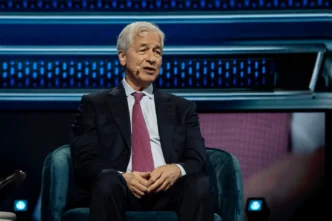

The relentless march of artificial intelligence into the workplace has sparked widespread discussion about job displacement, yet a surprising consensus is emerging from some of the most influential figures in finance and technology: the future of work, even with advanced AI, hinges significantly on distinctly human attributes. Jamie Dimon, CEO of JPMorgan Chase, recently articulated this perspective, suggesting that while AI will undoubtedly eliminate jobs, the demand for critical thinking, emotional intelligence, and effective communication will only intensify. His advice to those navigating this evolving landscape is straightforward: cultivate these “soft skills” to remain indispensable.
Dimon acknowledged that the speed of AI implementation could outpace the ability of some workers to retrain, creating a transitional gap. He proposed that both government and corporations bear a responsibility in easing this shift, floating ideas such as relocation and income assistance to support individuals through the disruption. The underlying message is one of adaptation and continuous learning, emphasizing that new roles, potentially more rewarding ones, will emerge for those equipped with the right combination of technical aptitude and interpersonal finesse. He firmly believes that a mastery of skills, rather than a specific degree, will be the true currency in this new era.
This sentiment is echoed across the technology sector, where the very architects of AI are advocating for a renewed focus on human-centric capabilities. Microsoft CEO Satya Nadella, for instance, has underscored the growing importance of emotional intelligence and empathy. As AI increasingly handles analytical and technical tasks, Nadella argues that the unique human capacity for understanding and relating to others will become paramount. He posits that while intellectual quotient (IQ) remains valuable, it is no longer the sole determinant of success in a world increasingly shaped by intelligent machines. 
The impact of AI on employment is already quantifiable. Since 2023, more than 70,000 announced job cuts have been explicitly attributed to artificial intelligence, as companies leverage the technology to automate routine tasks and restructure their teams. This trend is expected to continue, prompting leaders to rethink the core competencies required for a thriving workforce. IBM CEO Ginni Rometty has also contributed to this dialogue, predicting that generative AI’s full integration into the workforce will place a premium on attributes like collaboration, sound judgment, and critical thinking. She highlighted that this kind of adaptability is inherently human and cannot be replicated or taught through traditional academic routes.
Rometty’s perspective suggests that AI will fundamentally redefine the skill sets necessary for nearly every role, transcending the relevance of college degrees or pre-existing expertise. The ability to “upskill” and embrace this fluid environment will be crucial for individuals seeking to remain competitive. The consistent thread running through these observations from Dimon, Nadella, and Rometty is clear: while AI assumes more of the computational and repetitive burdens, it simultaneously elevates the value of uniquely human attributes. The future workforce, they imply, will not just be about what you know, but how effectively you can think, communicate, and connect with others in an increasingly automated world.