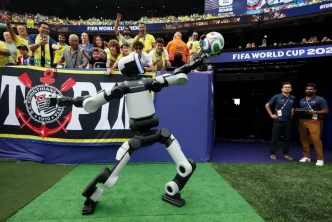
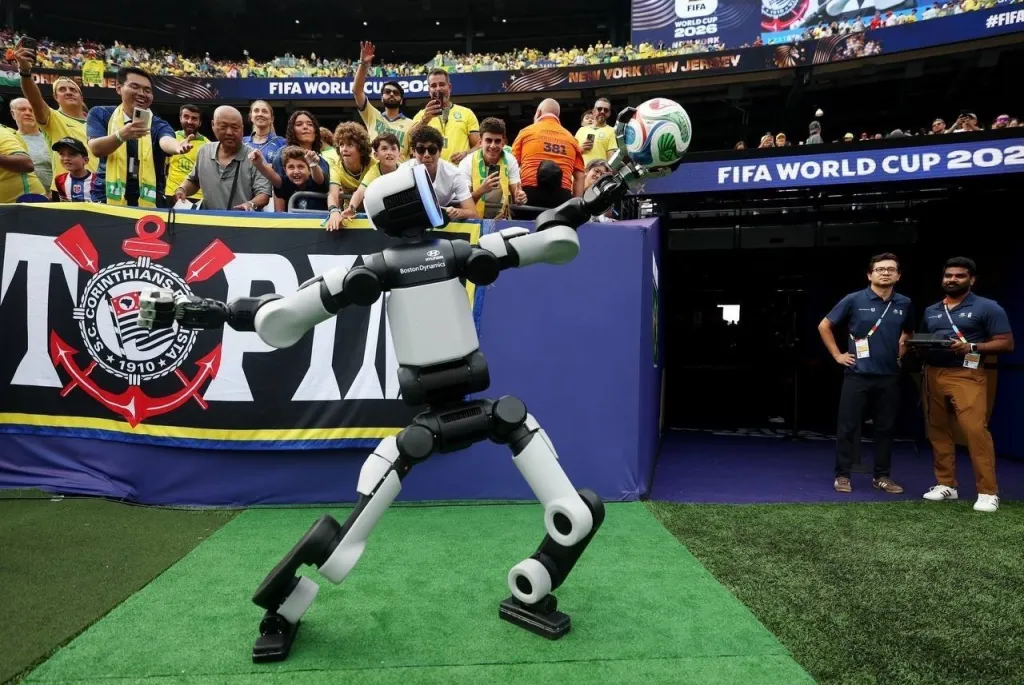
The roar of 80,000 fans at New York/New Jersey Stadium momentarily shifted from the impending Brazil and Norway Round of 16 clash to something entirely unprecedented. During halftime, a six-foot humanoid robot, known as Atlas, confidently strode onto the pitch. It didn’t just walk; it performed goal celebrations mimicking the likes of Harry Kane, Erling Haaland, Matheus Cunha, and Son Heung-min, before presenting the match ball to the referee. This moment, broadcast globally, marked a significant public debut for the Boston Dynamics-built machine.
This dramatic entrance was the culmination of five years of development, orchestrated by Hyundai Motor Company, a long-standing FIFA sponsor. Sungwon Jee, Hyundai’s executive vice president and global chief marketing officer, emphasized the strategic importance of this spectacle. He described the ball delivery as Atlas’s entry into public consciousness, signaling the start of its journey towards becoming a meaningful partner in human endeavors. Hyundai, which acquired Boston Dynamics, views this robotic advancement not as a peripheral venture but as a core strategic capability that will redefine mobility, extending beyond traditional automobiles to encompass autonomous systems and smart infrastructure.
Atlas represents the fifth generation of humanoid robotics from Boston Dynamics. Fully electric and roughly human-sized, it boasts 56 degrees of freedom, allowing for intricate movements, and can lift up to 110 pounds with a 2.3-meter reach. A key innovation lies in its autonomy; it can swap its own batteries, ensuring continuous operation. However, its most compelling feature, particularly evident in its soccer demonstration, is its learning capability rather than traditional programming. Alberto Rodriguez, Boston Dynamics’ director of robot behavior, explained that Atlas no longer relies on fixed instructions but learns behaviors through adaptation, much like large language models.
The robot’s preparation for the World Cup involved an intensive, unconventional training regimen. Instead of being programmed with specific movements, Atlas was shown footage of professional footballers, effectively studying the mechanics of the sport. Human motion-capture data, including engineers performing the desired actions, was fed into a physics-based simulation. This allowed Atlas to run through millions of repetitions in parallel using cloud GPUs, refining its movements and adapting to imperfect conditions. This process compressed what might take a human athlete a year of physical practice into approximately 24 hours of simulated learning.
One of the most significant challenges in preparing Atlas for the World Cup stage was adapting to the unpredictable nature of a soccer pitch. Unlike the controlled environments of a factory or lab, grass presents unique variables. Rodriguez highlighted the “interesting property” of grass where one might slip or get caught. This necessitated a complete overhaul of Atlas’s training regime for walking and running, ensuring it could perform reliably on complex surfaces like turf, in addition to concrete.
Engineers begin by demonstrating a desired movement, often through motion capture, which serves as a guide for Atlas. The robot then undergoes simulated repetitions under deliberately challenging conditions. Parameters are constantly manipulated: ground friction changes unexpectedly, the ball appears in incorrect positions, or Atlas is even “lied to” about its own foot size. This forces the system to develop robust behaviors that can execute tasks despite significant variables. Rodriguez noted that they “keep pushing it around, or lying to it about where the ball is, or putting obstacles on the ground, or changing the friction with the ground,” all to cultivate an adaptive intelligence rather than just rote execution.
This rigorous training results in what Rodriguez terms “muscle memory”—instinctual behaviors executed too rapidly for real-time calculation. The World Cup appearance served as a public demonstration of this advanced capability, showcasing that this new humanoid hardware can perform reliably even in extreme environments and high temperatures. Hyundai Motor Group’s ambition extends further, with plans for a dedicated robotics manufacturing facility in Georgia capable of producing 30,000 Atlas units annually by 2028. Atlas is already undergoing testing in Hyundai factories, focusing initially on tasks like part sequencing in automotive manufacturing, underscoring the company’s vision for robotics to reshape industrial processes and daily life.