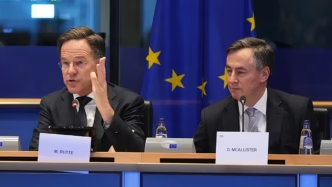
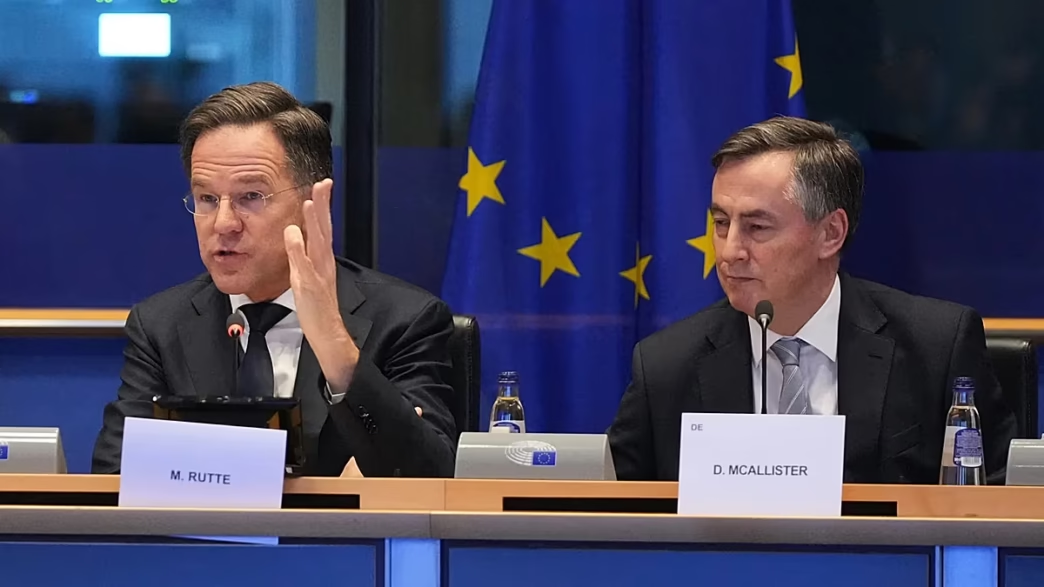
Secretary General Mark Rutte recently articulated a strong defense of Donald Trump’s influence on NATO, a stance that comes amidst considerable apprehension among European Parliament members regarding the U.S. President’s rhetoric towards the continent. Speaking to the Parliament’s committees on Security and Defence and Foreign Affairs, Rutte emphasized that Trump “deserves to be defended” and has contributed significantly to the alliance’s current trajectory. This perspective offers a counter-narrative to those who have interpreted Trump’s past statements and actions, such as his threats concerning Greenland, as detrimental to transatlantic unity, with Danish Prime Minister Mette Frederiksen previously describing such threats as “the end of NATO.”
Rutte specifically credited Trump with galvanizing NATO members towards increased defense spending. He contended that the target for all NATO countries to reach 2% of their GDP spending on defense by the end of 2025 would have been unattainable without Trump’s persistent pressure. He posed rhetorical questions to the MEPs, suggesting that countries like Spain, Italy, Belgium, and Canada would not have transitioned from approximately 1.5% to 2% without Trump’s intervention. Similarly, he doubted whether the commitment to a 5% defense spending target would have materialized in Trump’s absence, underscoring his belief that Trump’s assertive approach directly led to these financial commitments.
The Secretary General also indicated a selective admiration for Trump’s actions, noting that he commends the former President when he observes “good stuff” being done. This extends even to instances that might be considered unconventional, such as Trump’s public release of personal text messages. Rutte referenced a leaked exchange where he himself had described Trump’s decision to bomb Iran as “decisive” and “extraordinary,” suggesting a pragmatic appreciation for certain decisive actions, irrespective of diplomatic norms.
A core tenet of Rutte’s argument revolved around Europe’s fundamental reliance on American security support, a point he made unequivocally to the assembled MEPs. He dismissed any notion that the European Union could independently provide for its defense without U.S. assistance, stating, “If anyone here thinks that the European Union can defend itself without the US, keep on dreaming. You can’t.” Rutte further elaborated on the financial implications of such an endeavor, estimating that European countries would need to invest an extraordinary 10% of their GDP to develop their own nuclear weapons capabilities, an undertaking costing billions of euros. He warned that pursuing such a path would mean forfeiting the “ultimate guarantor of our freedom,” the U.S. nuclear umbrella.
In a related development, some MEPs acknowledged Rutte’s efforts in de-escalating tensions between the U.S. and the EU concerning Greenland, though they sought more details about the agreement reached with Trump. While specific terms were not disclosed, Rutte outlined two operational streams agreed upon with the Trump administration. The first involves NATO assuming greater responsibility for the defense of the Arctic region, aiming to curb Russian and Chinese influence. The second establishes a direct dialogue between the U.S. and the leadership of Denmark and Greenland, with talks already underway, albeit without Rutte’s direct mandate to intervene.
Beyond these points, Rutte also addressed the ongoing conflict in Ukraine, commending the EU for assembling a €90 billion loan package for Kyiv. He urged the Parliament to adopt a flexible approach, particularly concerning any strict stipulations that would mandate the use of these funds exclusively for European-fabricated weaponry. Rutte highlighted that while Europe is actively developing its defense industry, it currently cannot meet Ukraine’s immediate and future defense requirements. He stressed the necessity of providing Ukraine with what it needs today to defend itself and deter future aggression, even if that means sourcing from outside the European Union.