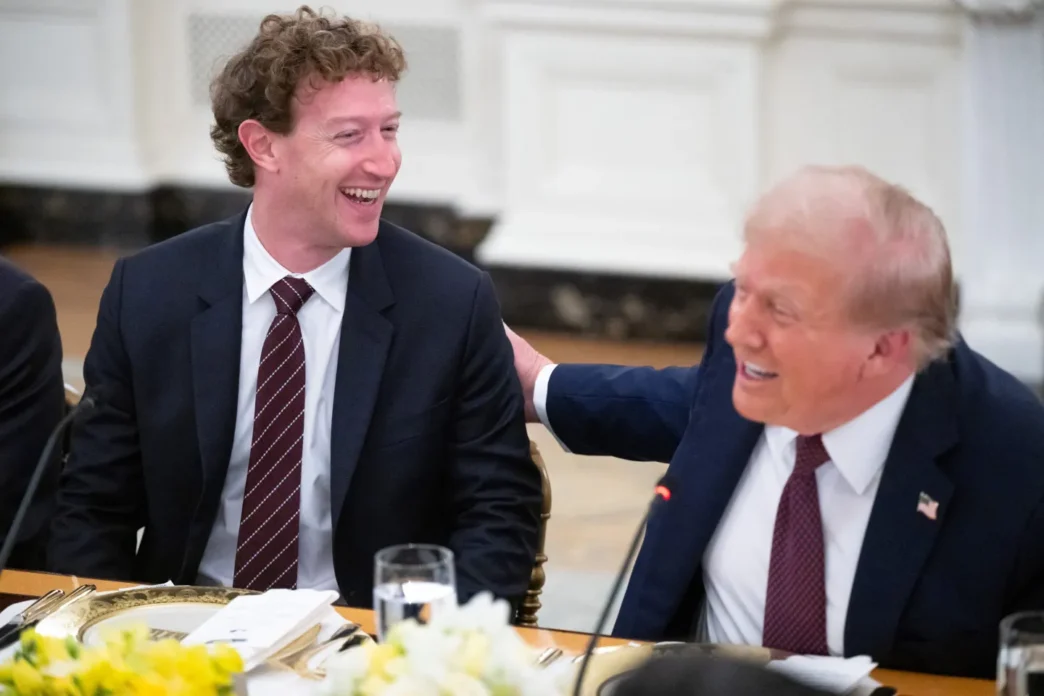
At the World Economic Forum, President Donald Trump recounted a striking image presented to him by Meta CEO Mark Zuckerberg: a proposed artificial intelligence data center complex so vast it appeared to engulf the entire island of Manhattan. Trump described the facility as “miles long, miles wide, and very high,” an observation that immediately drew attention to the sheer scale of modern AI infrastructure projects. This anecdote, shared during a post-address Q&A session, offered a glimpse into the colossal investments now defining the tech industry’s pivot towards AI.
The former president’s comments sparked a brief uptick in Meta’s stock, highlighting the market’s sensitivity to such high-profile endorsements and the perceived future of AI. While Trump characterized the project as a “big plant,” the specific facility Zuckerberg displayed remains unconfirmed. However, Meta is currently constructing its “Hyperion” AI data center campus in Richland Parish, Louisiana. This immense undertaking spans 2,250 acres, roughly equivalent to 1,700 football fields, and is projected to house 4 million square feet of data center space upon its completion in 2030, positioning it among the world’s largest silicon clusters. Yet, even this considerable footprint is dwarfed by Manhattan’s 22 square miles, suggesting either a rhetorical flourish on Trump’s part or a reference to an even more ambitious, unannounced Meta initiative.
Trump also drew a parallel between the estimated $50 billion cost of such a project and traditional real estate development, a field he knows intimately. He noted that while $500 million might fund a significant shopping center, a $50 billion price tag for an AI facility underscores a fundamental shift in capital allocation. This figure aligns with the projected cost for the Hyperion campus, illustrating the unprecedented financial commitments required to build the foundational infrastructure for advanced AI. Meta’s strategic shift from primarily a social media platform to an AI infrastructure behemoth is evident in its escalating capital expenditure guidance. The company anticipates nearly $72 billion in spending for fiscal year 2025, a 70% increase from the previous year, with projections for annual outlays potentially exceeding $100 billion by 2026.
Beyond the financial scale, Trump emphasized the immense energy demands of these “titan clusters,” noting that the U.S. electrical grid is ill-equipped to support the two to five gigawatts of power they require. During his Davos address, he outlined a policy directive aimed at streamlining the construction of private power generation facilities by AI companies. This initiative grants tech giants the ability to build their own on-site power plants, utilizing natural gas, coal, or oil, with a promise to significantly reduce bureaucratic hurdles. Federal approvals for these private energy projects, which typically take years, would be fast-tracked to just two weeks, provided companies invest in their own electricity generation.
This aggressive push for domestic industrial expansion in AI infrastructure forms a key part of Trump’s broader strategy, particularly in relation to international competition. He posited that American leadership in AI hinges on robust physical infrastructure, not solely on software advancements. He suggested that Chinese President Xi Jinping respects this rapid industrial execution, framing it as a critical advantage in the global AI race. While the U.S. currently leads China in areas like AI talent, investment, and access to semiconductors, China has demonstrated strength in AI-related infrastructure. Nvidia CEO Jensen Huang, speaking at the same forum, acknowledged China’s significant progress, citing the 2023 release of DeepSeek as a “major breakthrough” in open reasoning models, a field where Mark Zuckerberg has also shown considerable interest in open-source AI development.